
Part 1
Fun facts as people trickle in
Plants have more genes than animals do. Even though animals have more complex developmental programming than plants, the incredibly complex metabolisms of plants requires a lot of genes.
All plants have symbiotic relationships with fungi. The most common are micorrhyzal relationships with the roots, but there are also endophyte fungi that grow inside leaves and stems. Fungi help protect plants from drought, heat, disease, and being eaten. This relationship seems to go back 500 million years to when plants first colonized land.
Why and how to study botany
Humans learn a lot faster when we have categories that we can put things into and connections that we can make. It is easier to learn new plants, and new facts about plants, if you have the context of how they are related to other plants that you know.
A change in perspective can bring you into another world, in a mental and spiritual sense. Consider someone without interest in nature who sees a forest as a wall of green, and a lawn as simply “grass”. Someone who is foraging for a particular plant might quickly spot that plant but not notice details of any other plant that they pass. With a broad interest in the plant kingdom you will start to pay a lot more attention to many different plants, and can start to cultivate a personal and spiritual relationship.
My own relationship started when I was working in a lab as an undergrad, and found a plant growing forgotten in a Petri dish. Knowing its resources were limited, it had skipped most of its developmental program in order to produce a single flower (normally that species would grow about 6 inches tall and produce many flowers). Seeing a plant behave intelligently opened the door to seeing plants as having personhood, which in turn opened the door to having a spiritual relationship.
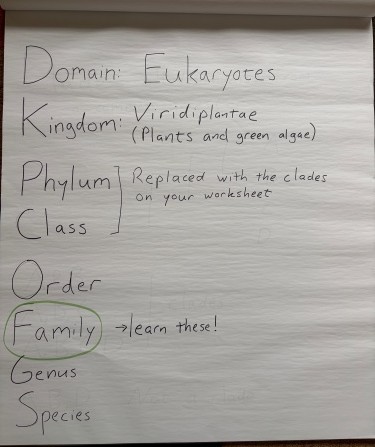
You may remember Kingdom-Phylum-Class-Order-Family-Genus-Species.
This system was invented before widespread belief in evolution.
Most plants don’t have a meaningful phylum or class.
I will use the term “clade” to refer to a group of organisms all arising from one common ancestor.
Nowadays, DNA sequence is considered the most trusted way of grouping organisms into clades.
The major groupings that we discuss in this workshop are clades that fall somewhere above order but below kingdom.
“Family” is a good level for a layperson to focus on. Thomas Elpel uses this approach in his book Botany in a Day. When plants are grouped into a family, it means the human brain is capable of noticing the similarities among those plants. For example, cucumbers, melons, and squash are all in one family. If you spend a lot of time with a particular species in your garden or backyard, you will learn characteristics of that plant at a subconscious level, and if you see a plant somewhere else that is in the same family, it will remind you of that plant in your backyard.
If you know the family of a plant, you can make an educated guess about its edible and medicinal properties. Emphasis on the “guess”! Check multiple trustworthy sources before putting anything into your body.
Families are grouped into orders, but usually based on characteristics that you would need a laboratory to sort out. For example, cacti, pokeweed, beets, amaranth, and Dianthus flowers (pinks) are all in the same order, based on the fact that they can all produce a hot pink pigment called betalain.

Flowers and fruits are the best organs to use for identifying a plant. They tend to have characteristics that are conserved within families. Whether something is an herb, a shrub, a tree, or a vine is not so useful; there are families that have all four of these! Likewise leaf shape can vary a lot within families. But once you know the family, those kinds of characteristics are useful for sorting out genus and species.
AI apps are helpful for making a first guess at plant ID, but you always need to check the results using a different source. I take the species ID that I get from the app, then look up that species on the Florida Plant Atlas and see if the pictures look like my plant.
Don’t get intimidated by botanical descriptions. They have a lot of jargon, but almost all of it is something that a layperson can learn with a Google search. For example “glabrous” just means “hairless”.
When you look up a species on Wikipedia, there is a “scientific classification” sidebar linking to the various clades that it belongs to. Clicking on those can help you learn about different groupings of plants.
The Phytomemetics group on Facebook is fun and I have learned a lot by Googling things I see on there. Crime Pays but Botany Doesn’t is also really interesting and entertaining.
I think it is better to have intimate knowledge of a few plants than shallow knowledge of many, especially if you are trying to develop a spiritual relationship with plants. Spend some time regularly appreciating the details of a plant over the course of the year, and watch its patterns of growth and its response to the seasons and weather. At the same time, learn what family that plant is in and if there are other local plants in that family.
There is always more to learn! Take your time and have fun.
Anatomy
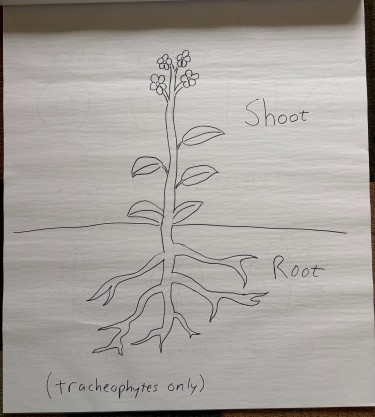
The most basic anatomical division is “root” (below ground, absorbs water and nutrients) vs. “shoot” (above ground, does photosynthesis).
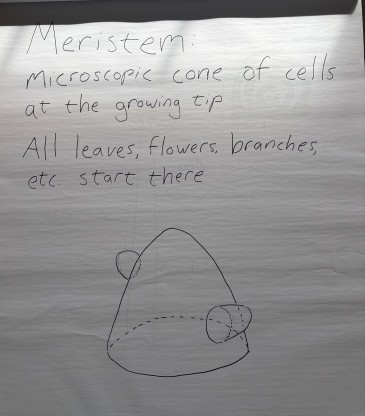
The equivalent of “stem cells” in a plant is a microscopic cone of cells called the meristem. These are found at the growing tip of a root or shoot. Right above where a leaf connects to a stem you will usually also find a dormant meristem, which can grow into a new branch if the plant is injured. Shoot meristems usually aren’t exposed to the open air, but instead are wrapped in very young leaves, forming a bud.
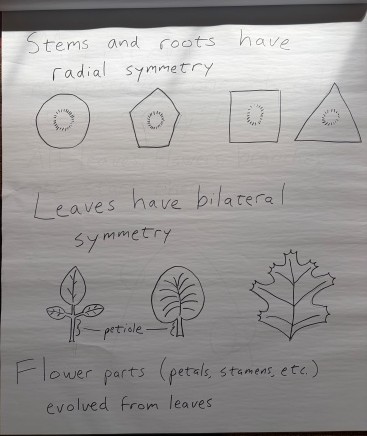
Roots and stems have radial symmetry. Leaves have bilateral symmetry. Flower parts like petals and stamens evolved from leaves. The stalk that connects the leaf to the stem is called a petiole and is part of the leaf.
Along the stem, you will find sections called “node” and “internode”. The internode is just stem and doesn’t have the capacity to grow into anything else. The node is where you find a leaf and a bud or branch.
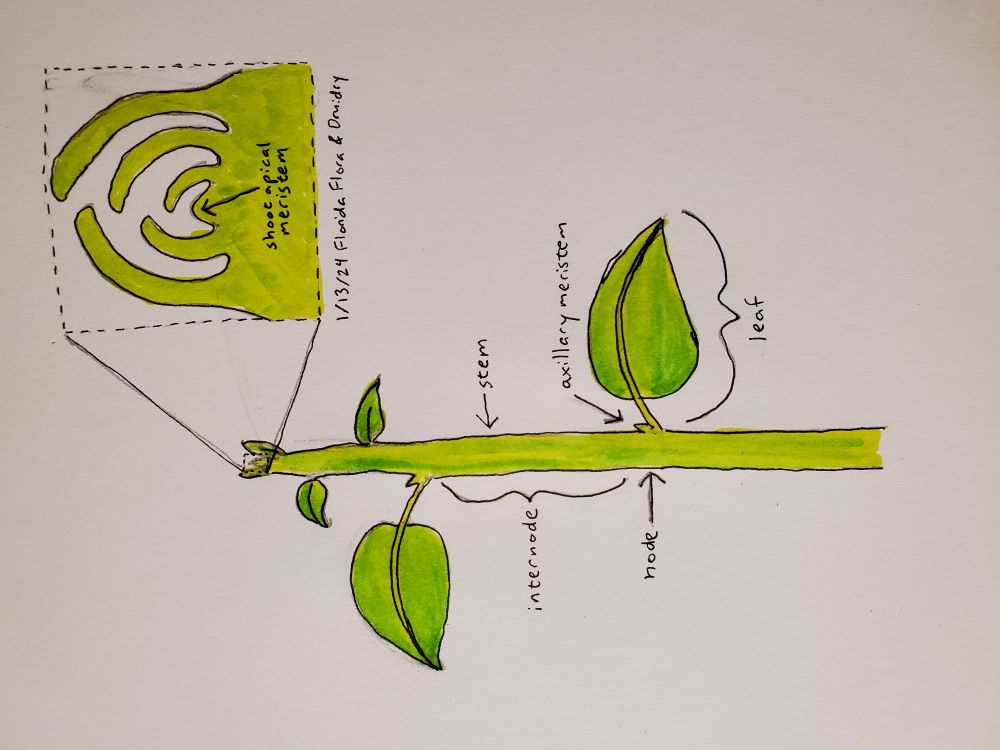
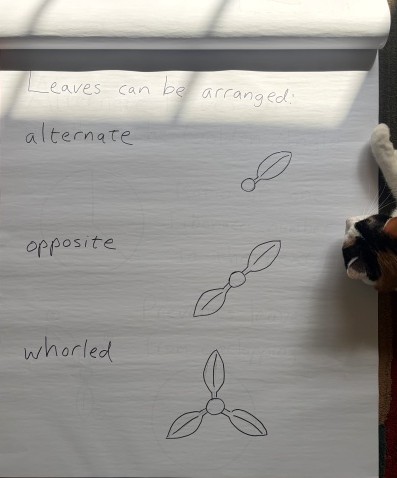
The way that flowers and leaves are patterned around the axis of the stem is called “phyllotaxis” and starts as little bumps that emerge on the meristem. Those bumps send hormonal signals so that they are spaced apart nicely. When two leaves emerge at the same node, 180° from each other, it is called “opposite”. When one leaf emerges from a node, and the next leaf emerges from the other side of the next node, it is called “alternate”.
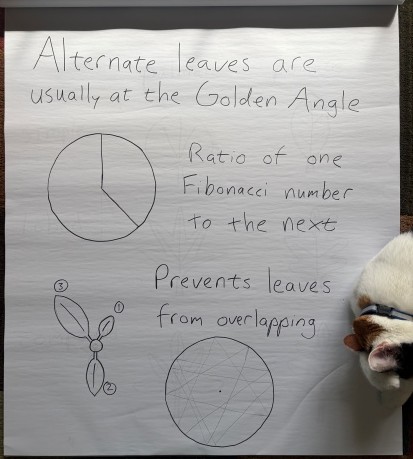
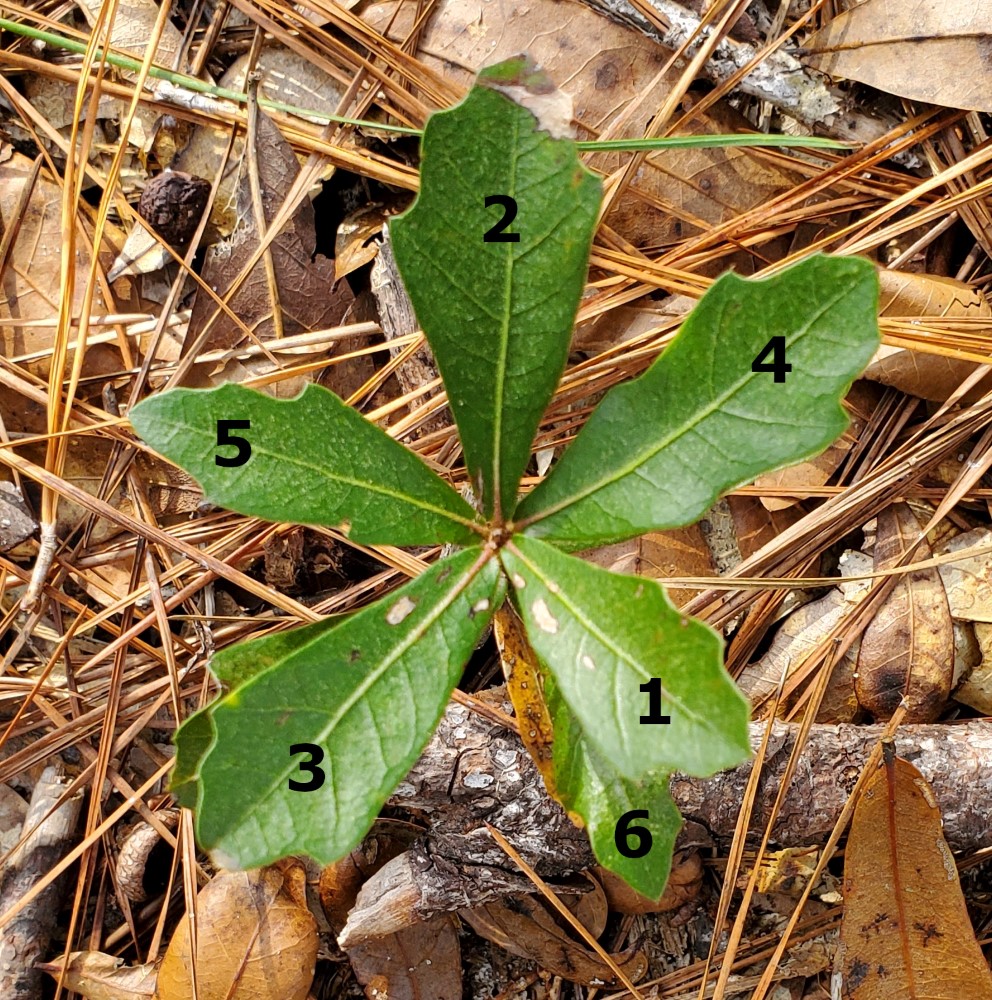
Alternate leaves almost never emerge 180° from each other. They usually emerge at the golden angle, which is a little more than a third of the way around the circle. Because the golden ratio is an irrational number, this means that two leaves will never be stacked directly on top of each other. This also results in spiral patterns in which we can see Fibonacci numbers (see blog post).
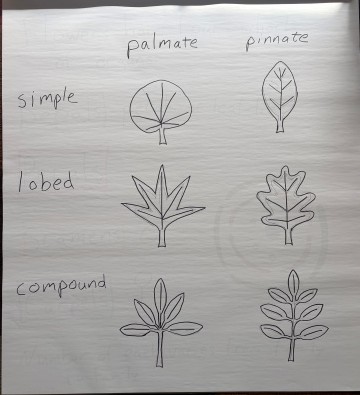
Leaves can be simple, lobed, or compound. A compound leaf with many leaflets is still just one leaf, anatomically speaking. If the veins all radiate out from one central point, it is called “palmate”, and if they come out from a central axis it is called “pinnate”.
To understand the evolution and development of flowers, consider a pine cone (which is not a flower, but probably resembles an ancestor of flowers). Each scale is a modified leaf, and on the underside of a scale there are cells that produce pollen or a seed by meiosis. All the scales are identical, and the exact number of scales varies from cone to cone.
Next consider water lilies, which probably resemble one of the earliest flowering plants. The exact number of flower parts varies from flower to flower, but now there are different categories of organs, like petals to attract pollinators and stamens to produce pollen.
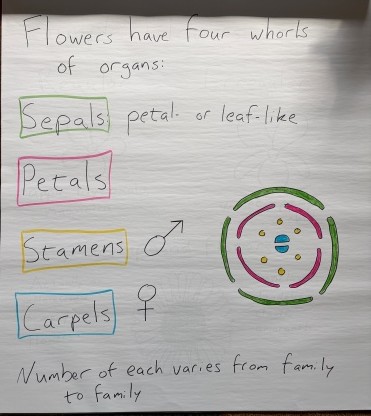
Flowers are made of four whorls of organs:
“Sepals” are on the outside and are usually leaf-like, sometimes petal-like.
“Petals” are next. In species where sepals and petals are indistinguishable, like magnolias and lilies, they may both be called “tepals”.
“Stamens” are next and produce pollen.
“Carpels” are the innermost whorl, produce ovules, and receive pollen. Carpels may be fused into a “pistil”.
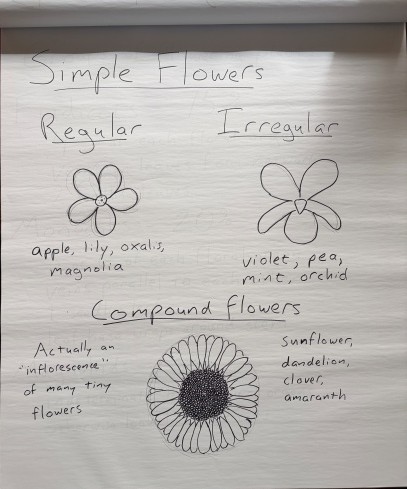
If you don’t see the typical four whorls, consider whether you could be looking at a compound flower that is made of many tiny flowers (for example, sunflowers, clover).
Most families of flowering plants have an exact number of organs on each flower, unlike pine cones or water lilies.
A flower is “regular” if it has radial symmetry (for example magnolia, cherry) and “irregular” if not (pea, mint, orchids).
Some flowering plants, like grasses or oak, have evolved back to wind pollination, so the flowers are not very showy, but they are still technically flowers.
Some species have a modified leaf, called a “bract”, at the base of a flower or group of flowers.
Discussion: What part of the plant is a celery stalk? What part of the plant is cauliflower?
Part 2
Activity intro
We are going to do a worksheet and then have a discussion in order to learn about plant evolution and major groups of plants.
I made the worksheet based on this DNA study from 2020, my own knowledge that I have accumulated over the years, and a bunch of Googling to find when various groups first appear in the fossil record.
Older sources will show different relationships among the plant lineages. Science is a work in progress!
All of the clades on the worksheet are below the rank of Kingdom but above the rank of Order.
It is tempting (even for biologists) to assume that if two tips of the tree are next to each other, those two groups are close relatives. Not necessarily! To determine how closely related two groups are, trace their branches back in time until you find their last common ancestor. The further back in time that is, the more distantly related the two groups are. For example, ginkgo is more closely related to asterids than it is to ferns, despite how I drew my tree.
Imagine hanging this tree like it was a mobile over a baby’s crib. Any of the forks could rotate around, and the tree would retain the same meaning.
Activity
Think of some plants that you enjoy. These can be foods, herbs, garden plants, trees, or any others that interest you.
Google the plant and find its Wikipedia page. Find a side bar labeled “Scientific classification” and find the family that the plant belongs to. This is a Latin word ending in “aceae”. Above the family, look at the clades and find which clade the family belongs to. Write the plant and its family in on the worksheet, connecting them to their clade with a line.
It’s okay to use common names for families, e.g. “mint family” vs. “Lamiaceae”.
For at least one or two families, go to the Wikipedia page for the family and learn what other plants are in that family.
I deliberately put the biggest groups towards the middle of the worksheet, so feel free to draw diagonal lines outward if you need to.
Work together with friends to cover more ground!
Questions for when we are done
What questions came up while doing this activity?
What did you learn that was interesting?
I will go through the different clades and ask people to say what plants they found in that clade.
Major clades of flowering plants
The scientific term for flowering plants is “angiosperms”.
Flowering plants first appear in the fossil record about 130 million years ago, although DNA “molecular clock” evidence suggests they may be older than that. In any event, they exploded in diversity and abundance during the Cretaceous, which is the last age of the dinosaurs. So, imagine stegosaurus without any flowers around, but T. rex with lots of flowers.
Despite being so “young”, angiosperms make up 90% of all modern plant species.
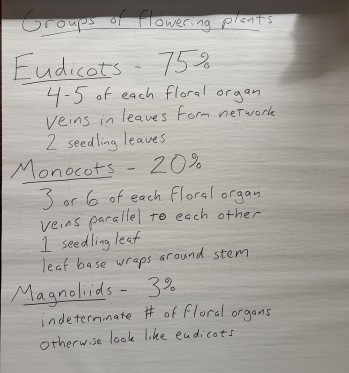
Most flowering plants fall into these three groups: Eudicots, Monocots, and Magnoliids. These three all diverged from each other around the same time. A few other groups, like water lilies, diverged earlier.
The “cot” refers to “cotyledon”, which is a seedling leaf.
On a seedling, think of the first two leaves that emerge, and look simpler than all the other leaves. These are the cotyledons.
Monocots have one cotyledon.
Eudicots and Magnoliids have two cotyledons.
The “eu” just means “true”. There are more Eudicots than Magnoliids, so Eudicots are the “true” dicots.
Conifers usually have more than two cotyledons, but conifers are not flowering plants.
Eudicots make up 75% of all flowering plant species. Their flowers have a set number of organs, usually four or five in each whorl, depending on the family. The veins in the leaves form a network. If you take any random plant and guess that it is a eudicot, there is a good chance that you are right.
Monocots make up 20% of all flowering plant species. They are pretty easy to identify; in short, grass or anything that reminds you of grass. The veins on the leaves run in parallel to each other and don’t cross or intersect. The base of the leaf usually wraps around the stem. Because of how the vasculature is organized in the stem, there are very few monocot trees, and those that exist, like palm trees, are pretty different from most other trees. The flower parts are always in multiples of three.
Magnoliids make up 3% of all flowering plant species. They look a lot like eudicots, but their flowers do not always have a set number of organs. For example, Southern magnolias usually have nine or twelve tepals and many stamens and carpels.
Eudicots, Monocots, and Magnoliids can also be distinguished by the shape of their pollen and how the vasculature is arranged in the stem, but these traits aren’t very accessible to a layperson.
Non-seed bearing plants
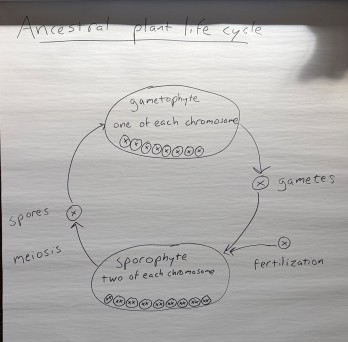
To really understand plant reproduction, you need to know that there are two phases to the lifecycle of all plants and green algae:
Sporophyte: has two of each chromosome. Produced by two gametophytes fusing together.
Gametophyte: has one of each chromsome. Produced by meiosis from the sporophyte.
So it’s kind of like animal reproduction, except that the gametophyte can divide and grow as a multicellular organism, and in many cases lives free and independent of the sporophyte.
In all land plants (and some algae) the gametophyte and sporophyte stages are totally different from each other in terms of how they grow and develop.
In moss, the green leafy stuff is the gametophyte stage, and the brown stalks are the sporophyte stage. Raindrops help one gametophyte to fertilize another, producing a sporophyte which undergoes meiosis to make spores that fall on the ground to grow into new gametophytes.
In all tracheophytes, the gametophyte stage is something microscopic and/or not free-living, and what we think of as the “plant” is the sporophyte stage.
In ferns, the big leafy plant is the sporophyte stage. If you see black dots on the underside of the leaf, this is where meiosis happens and gametophyte spores fall to the ground. Those spores grow into microscopic plants, called thalli because they don’t have distinct leaves and stems. One thallus fertilizes another to produce a new sporophyte.
A pine nut is actually a really big gametophyte surrounding a sporophyte embryo. (Pines are seed-bearing plants unlike moss and ferns.)
Sperm contained within the pollen of seed-bearing plants are the gametophyte stage. Ovules of flowering plants are also the gametophyte stage.
Part 3
Let’s go outside!
Anatomy
Can we find a plant with opposite leaves?
Can we find a plant with alternate leaves at the Golden Angle?
Find a plant with compound leaves. Are they palmate or pinnate?
Can you find a bud (containing a meristem) at the base of each leaf?
Look at grasses or a palm tree, or for extra challenge, a fern. Can you tell what is a leaf and what is a stem?
Find a plant that is flowering. Is it a compound flower or a simple flower? Is the flower regular or irregular? If the flower is big enough, can you identify the four whorls of organs?
Taxonomy
Planted around Camp Kiwanis we’ll find Florida’s native cycad, coontie. When you see one of these, check to see whether it is growing a cone (like a conifer).
Which trees are angiosperms, and which are gymnosperms?
Let’s look at Spanish moss (a monocot) vs. actual moss.